Wednesday, March 21, 2018

Digital Vs Analog - WAC

Related image
commons.wikimedia.org
As seen in the standard of today's music industry, everything is digital. Digital technology has allowed us to exceed all limitations that Analog technology constricted us to. Although, this does comes at a price that I am more than willing to pay as a recording artist. That price, of course, being quality. As you already know, digital signals take the approximation of an analog signal to fit a certain given bitrate. As a recording artist, I want my music to be in a digital format. This mainly is for the abundance of reasons that artists today use digital technology, namely being that its cost efficient, space efficient, modifiable, extremely relevant in today's music streaming based world, and so many more.

The first reason that I want to have my music in a digital format is because of how clean and crisp it makes the sound. When I listen to my digital recordings, there is no background noise, no tape hissing, nothing like that. I get a sound that is very clear and has no static. This can be seen in the video Analog or Digital? quoted by Michael Fremer. He says at 0:57 "Digital has certain perfect things about it, it immediately solved all the problems of analog. Background noise, Hiss, wearing, pitch control, all of those things." this can also be seen later in the video said by the narrator at 2:10 "CD's generally sound better than vinyl on the average turntable and cassette are just dubs made from digital masters. It takes a good stereo with a good turntable to hear the subtleties that CD's seem to miss." As seen in both of these quotes, the subtleties in the difference of quality is pretty hard to hear and you overall get less unnecessary noise. On top of all of this, quality of digital technology has improved drastically over the years, and now it is even harder to tell the difference.

The next reason why I want my music done digitally is because of its space efficiency. With digital media, you can store so much more in a limited amount of space. With analog technology you had to store everything on vinyl or casset tapes that takes up unnecessary amounts of space. Now, with digital technology, you can store so much more just onto one mp3 player, or CD, or not even any physical item. With the recent boom of music streaming platforms (ie. Spotify, iTunes, Soundcloud ect.) it is a requirement to have it in a digital format, and can be streamed from anywhere as long as you have your phone. These services have been extremely prevalent in today's music world and if you want your music to be out there, you will need to have it in a digital format. You also don't need nearly as much equipment to do digital music. It takes up far less space and is much more efficient. This can be seen in the quote from the article Analogue Vs Digital: Advantages Vs Disadvantages by user Charman2010 "Digital equipment is far easier to store as it doesn’t take up as much space as with analogue equipment". This is another reason why I want my music to be in a digital format.

My final reason why I want my music in a digital format is because of the freedom you have to edit and change certain things that are unclear or un-concise. This can be seen in the quotes from the article Analogue Vs Digital: Advantages Vs Disadvantages by user Charman2010. "Digital is far easier to edit, you can chop, edit and manipulate audio within a matter of minutes. There is also an undo button with digital meaning if you accidentally delete something or mis edit something that doesn’t work, you can undo without having to start again". This clearly shows that digital audio is superior in flexibility and efficiency. Another example of this can also be seen in the same article. "Digital equipment is also far cheaper when buying outboard gear, software and plug ins needed to record achieve certain processing techniques". This shows that with digital media, it is much cheaper, easier to edit, and overall less of a waste of resources.

I already know what your thinking, and what your main argument for "pro-analog" is. it's that analog recordings are "better quality" and "more human like". This is a popular opinion of those that want to still keep their music in analog technology. This can be seen in the quote from the Recording connection article Analog, Digital, What is the Difference? "to many people, analog sound tends to be warmer, has more texture and is thought to capture a truer representation of the actual sound. Digital is felt to be somewhat cold, technical and perhaps lacking in analog’s nuance". This shows that people only have this as their opinion. You might think that it sounds better analog, and that's fine, but let's look at the facts. Digital audio can not only potentially "sound better" in someone people's opinions, but can also be factually proven to be better and more efficient.  This similar opinion can be seen in the article from before "The idea between digital recording is that our ears and brains technically can’t determine the spaces between the digital values, just like our brains interpret film as continuous motion". This is my counter argument against the main reason people are pro-analog. 

So, in conclusion, as a recording artist, I certainly would like my music to be in a digital format. Not only because the pro's of digital media clearly outweigh clearly outweigh the one disadvantage being sound quality. It is more efficient, cost effective, easier to manage/store, and much more customizable in the way you want to make your song sound like. The reality is that analog technology is ancient and entirely replaced by digital, so doing it in an analog format would be entirely pointless. And with that being said, Those are all of the reasons why I want my music to be in a digital format.

Sunday, March 11, 2018

Different Types of Waves and How They Travel: Weekly Blog #17

Image result for different types of waves
www.smartsciencepro.com
Summary 

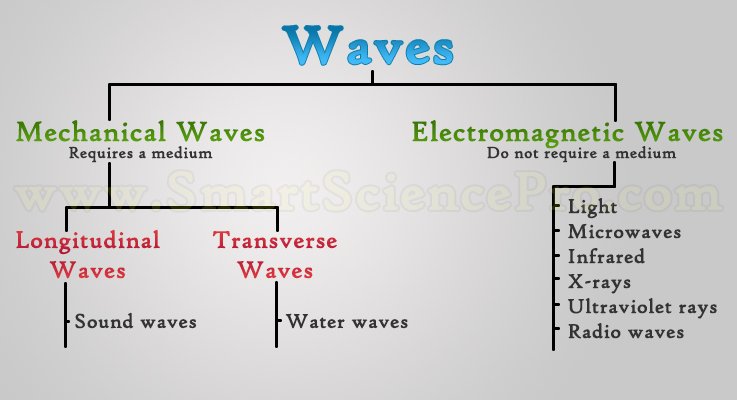
This week in science, I learned about different types of waves and how they are used everywhere around me. Waves can be put into 2 different major categories, mechanical waves and electromagnetic waves. The difference between them is that mechanical waves require a medium to travel through while electromagnetic don't. Then, mechanical waves can be broken down into 2 categories, longitudinal waves and transverse waves. Sound waves also travel differently depending on which medium they travel through. When sound travels through a solid, it travels at the same speed that it typically would. When it moves through a liquid, it travels slower due to the molecules being not as close. In a gas, sound travels very slowly because the molecules are so far apart.

S&EP - Using models

This week, we did an experiment using slinkys. These slinkys were used to model the differences between longitudinal and transverse waves. In transverse waves there is a displacement in molecules that go through compression and rarefaction's. This was exemplify through the slinky because of the spring expanding in certain areas and tightening in others when it was pushed. Longitudinal waves travel up and down and have a trough and crest, so this was shown when we waved the slinky up and down. this created waves that resulted in having a trough and a crest and bounced up and down when moved in that matter.

XCC - Energy and Matter

This week in science, we had to deal with energy when it came to sound waves. The movement of energy is clearly present in sound waves. This is due to sound waves being a way of transferring energy. In sound waves, energy is carried through vibrations. But, it isn't only in sound waves that carry energy, in fact, all waves carry energy. Electromagnetic waves transfer energy in all sorts of different ways. Electromagnetic waves carry electromagnetic energy and depending on the different wave lengths and frequencies of the waves. These different types of waves are organized on the electromagnetic spectrum.

Wednesday, March 7, 2018

Quiziz Regrade

Question: How much of the electromagnetic spectrum is visible?

Answer Before -  None of it X

Correct Answer - Only a small part 

Why is this the correct answer? 

Light is visible in the electromagnetic spectrum so even though it is only a small part, it is still visible.

Question: The action of a wave bouncing off of a surface is called

Answer Before - Refraction X

Correct Answer - Reflection


Why is this the correct answer? 
The difference between refraction and reflection
Question: 12

Answer Before - When distance = 90 and speed =185. X

Correct Answer - When distance = 15 and speed = 20 

Why did I get this question wrong? When calculating speed i put time/distance not distance/time.

Sunday, March 4, 2018

How Sound Works: Weekly Blog #17

Related image
www.scienceaid.net
Summary 

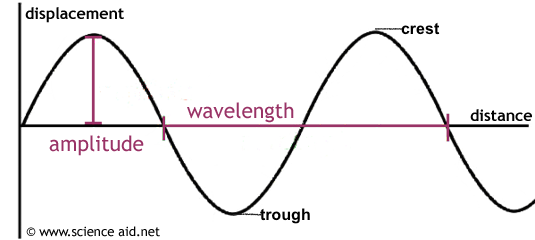
This week in science, I learned about how sound functions. Sound is a vibration of molecules, in other words, a motion that can transmit energy through matter. that has different elements that contribute to how it sounds.  The first think I am going to talk about is pitch. Pitch is how essentially just how high or low a sound is, but depends on the frequency of the sound. A sound frequency is how fast or slow a sound is. The amplitude of a sound is how loud a sound can get or the maximum extent of a vibration. How loud a sound is measured in DB or decibels that can also be expressed as the amplitude. Because sound is measured in waves, there are many different wavelengths present in the vibrations. depending on how close the vibrations are depends on how high the pitch will be. This is what I learned this week in science

S&EP - Using models

This week in science, there was a heavy use of models to help us understand how sound interact with the different environments and situations surrounding it. The first experiment that I am going to talk about is the tuning fork and water experiment. Through this experiment, I was able to see the different effects that sound waves vibrations can have on water. I saw that the vibrations that come off of sound waves were clearly present because it made splashes in the water and also was a able to make the ping pong ball (second part of the experiment) bounce on impact.We also did a different experiment where we tried blowing on different bottle and depending on how much water there was in each one changed the pitch of the sound.

XCC - Structure and Function

There was a great factor of structure and function that I noticed when studying sound this week.In order for us to hear sound, there is a series of events that occur before that can happen. Our ears are structured in a certain way that allows us to process sounds, and each part serves a different function. When there is sound, there is a vibration of molecules in the air. Those vibrations reach our eardrums and makes our eardrum vibrate. Then, the little hairs lined across the eardrum send signals to your brain, and that's what makes you perceive sound as. This is related to structure and function because without all the little components of your ear being structured the way they ware, we would not be able to hear sound the was that we do.

Sunday, February 18, 2018

Roller Coaster Project Blog

Our Roller Coaster

Summary

For this project, we were given the task to create a roller coaster that exemplifies all of Newton's Laws, as well as several elements of physics that we have been studying. We were able to do this using insulation tubes, dowels, and a marble as our cart. In order to do this, we had to learn key concepts including kinetic energy, potential energy, speed, acceleration, velocity, and force. How our roller coaster shows these elements is quite simple. When at the beginning of the first hill in the track, it has a great amount of potential energy. This is actually where the potential energy is the highest. When the marble has just finished a hill, the kinetic energy is the highest. Obviously, speed and acceleration are prevalent all throughout the course because that what keeps the marble going.

Backward Looking: What process did you go through to produce this piece?


In order to make this project happen, we had to go through a series steps that would eventually lead to our final product. This includes the making the initial design, experimenting with what worked, and what didn't, testing different designs. After we were done with this phase, we went onto recording different runs, calculating different elements and putting it all onto the design brief. Once all of this was done, all we had left to do was finally decorate and perfect the track. After we were done with all these steps, we had to reflect upon our work on this reflection.


Inward Looking: What did/do you find frustrating about it?


What we found very difficult to get right was trying to get the marble to come to a complete stop. We tried so many different methods in trying to make it stop. The first method we used was trying to get tape to increase friction while on the track. With increased friction of the tape, we were then able to make it come to a more gradual stop. After a while, we realized that it actually wasn't helping much at all. So, what we the decided to do was add a little bump of tape and elevate it at the end. With using this method, we were able to make the marble go over the bump and in turn slow it down, and then it would go over the hill, causing it to have much less speed, and come back to the bump and stop.


Outward Looking: Did you do your work the way other people did theirs? In what ways did you do it differently? In what ways was your work or process similar?


In a sense, I believe that everyone did similar work. Everybody had the same materials to work with, it just mainly had to do with whatever creative spin you can put onto it. For us, we decided to used a tri-fold piece of cardboard to help support the hill in the beginning. We saw that a lot people were doing this because it helped reduce the cost of their materials, and also gave a sturdier surface that it can go off of. We saw that a lot of people made their tracks focused on how long they could make it, and have a lot more twists and hills. For ours, we decided to mainly focus on functionality instead. We decided to have more elements that could support the weight of all the parts in the track, as well as make it have all the necessary elements, creative ideas, and a speedy "cool" looking track.


Forward Looking: One thing I would like to improve upon is


I guess if I were to improve something about the roller coaster, I would most probably add more decorations, and overall make it look more sophisticated. If we didn't have as much random tape everywhere, and overall make it look a lot more clean and neat, it would have been a much better looking project. Another thing that I would most like improve on is making the dowels more in place and secure on the track. By doing this, we could have avoided a lot of the errors and problems that we started running into along the way.

Sunday, February 11, 2018

Making My Own Rolar Coaster! : Weekly Blog #16

Related image
www.worldsciencefestival.com

Summary  - 

This week in science, we were given the task to create a roller coaster that exemplifies all of Newton's Laws, as well as several elements of physics that we have been studying. We were able to do this using insulation tubes, dowels, and a marble as our cart. This includes concepts such as kinetic energy, potential energy, speed, acceleration, velocity, and force. How our roller coaster shows these elements is quite simple. When at the beginning of the first hill in the track, it has a great amount of potential energy. This is actually where the potential energy is the highest. When the marble has just finished a hill, the kinetic energy is the highest. Obviously, speed and acceleration are prevalent all throughout the course because that what keeps the marble going.

S&EP - Conducting Investigations

Through this roller coaster, our team decided to collect the different data point in which important events in our roller coaster occured. Some examples of this could be when the acceleration was the highest, which locations had the most potential energy, and which had the most kinetic energy. When trying to figure out what types of loops and hills worked with our track, we also chose to control the height and length of the loops and hills. We had to do this so we would know how the different elements in our track could work.

XCC - Cause and Effect

One great example of cause and effect in the roller coaster can be seen with the us deciding to put tape on the track. The cause of this was because the main problem we ran into was trying to make our marble come to a complete stop. We then decided to change the amount of tape we put in seperate parts of track. When putting down tape we saw that it had an effect of the amount of friction that the marble experienced, causing it to slow down. This shows cause and effect by having the tape exemplify an alternate way of making the marble come to a complete stop, and introducing a different twist on the friction present throughout the rest of the track. The cause of us doing it being because we couldn't get it to stop, and the effect being us putting on tape because it increased friction.

Sunday, February 4, 2018

Studying Kinetic Energy and Potential Energy: Weekly Blog #15

Image result for kinetic energy
www.differencebtw.com

Summary

Kinetic and potential energy are two very different types of energy. When something has kinetic energy, that means that it is energy in motion. This is quite a bit different from when something has potential energy. Potential energy is when an object has a lot of energy inside of it, and if force were to be applied, it would release that energy. This can be seen in Newton's third law, with every action comes an identical and opposite reaction. Potential energy has to have enough work put into it in order to have a reaction of work.

S&EP - Analyzing Data

This week we had to analyze the changes in data between differently placed items that were put on a variety of shelves. This was done by using a gizmo simulation.
XCC - Stablitity and Change